
Gold basics
MCX Gold vs XAUUSD: What's the Difference?
Quick answer
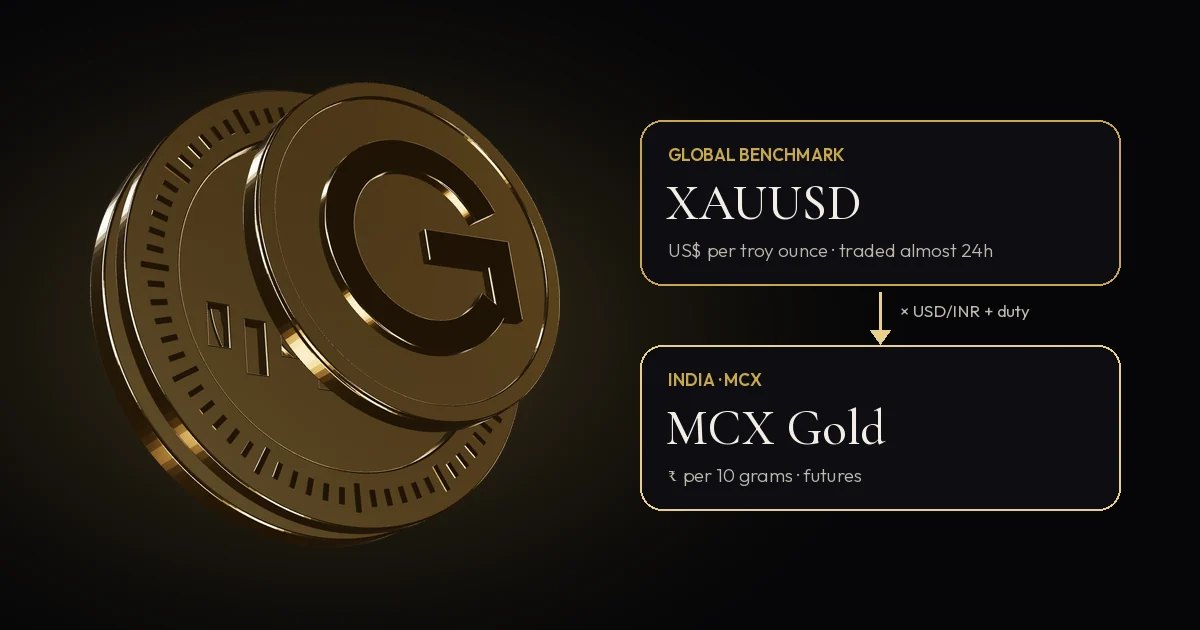
MCX Gold is a rupee-priced gold futures contract on India's Multi Commodity Exchange, quoted per 10 grams with import duty built in. XAUUSD is the international spot price of gold in US dollars per troy ounce, traded almost around the clock. Both follow the same global market, but currency, taxes, units and trading rules make them move differently.
Key takeaways
- XAUUSD is the global benchmark: US dollars per troy ounce (31.1035 grams), traded over the counter almost 24 hours on weekdays.
- MCX Gold is India's exchange-traded futures price: rupees per 10 grams, including import duty but excluding GST.
- A weaker rupee lifts MCX Gold even when XAUUSD hasn't moved, so MCX traders watch USD/INR as closely as gold itself.
- MCX offers five gold futures sizes, from 1 kg down to 1 gram, each with its own purity and expiry rules.
- Residents of India may trade forex only through authorised channels; check the rules before trading XAUUSD with any overseas platform.
Gold has one global price, but traders in India meet it in two very different forms: MCX Gold, traded on the Multi Commodity Exchange in rupees, and XAUUSD, the international spot price in US dollars. Knowing how they differ explains a lot of "why did MCX move when gold didn't?" moments.
What is XAUUSD?
XAUUSD is the price of one troy ounce of gold in US dollars. It is the global benchmark that bullion dealers, central banks, funds and futures markets refer to.
- Unit: one troy ounce, which is 31.1035 grams.
- Market: spot gold trades over the counter between banks and dealers, with futures in New York feeding into the same price.
- Hours: almost around the clock on weekdays, as trading passes from Asia to London to New York.
For Indian clients, the busiest windows are usually the London open (around 1:30 PM IST) and the New York session (from around 6:30 PM IST), when liquidity and volatility pick up.
What is MCX Gold?
MCX Gold is a gold futures contract traded on India's Multi Commodity Exchange. You trade it through an Indian commodity broker, in rupees, and you deposit margin rather than paying the full contract value.
MCX lists gold futures in five sizes:
| Contract | Lot size | Purity | Expiry |
|---|---|---|---|
| Gold | 1 kg | 995 | 5th of the month |
| Gold Mini | 100 grams | 995 | 5th of the month |
| Gold Ten | 10 grams | 999 | Last trading day of the month |
| Gold Guinea | 8 grams | 999 | Last trading day of the month |
| Gold Petal | 1 gram | 999 | Last trading day of the month |
Gold, Gold Mini and Gold Ten are quoted per 10 grams. Contract details can change, so always confirm the latest specifications on the MCX website before you trade.
Why don't the two prices match?
Because MCX Gold is the global price, translated into Indian conditions. Three things sit between them:
- Currency. XAUUSD is in dollars; MCX is in rupees. If the rupee weakens against the dollar, MCX Gold rises even when XAUUSD is flat.
- Units. XAUUSD is per troy ounce; MCX is per 10 grams (about 0.3215 troy ounces).
- Import duty and levies. The MCX price includes import duty and other levies but excludes GST, so it normally sits above a simple currency-converted XAUUSD price.
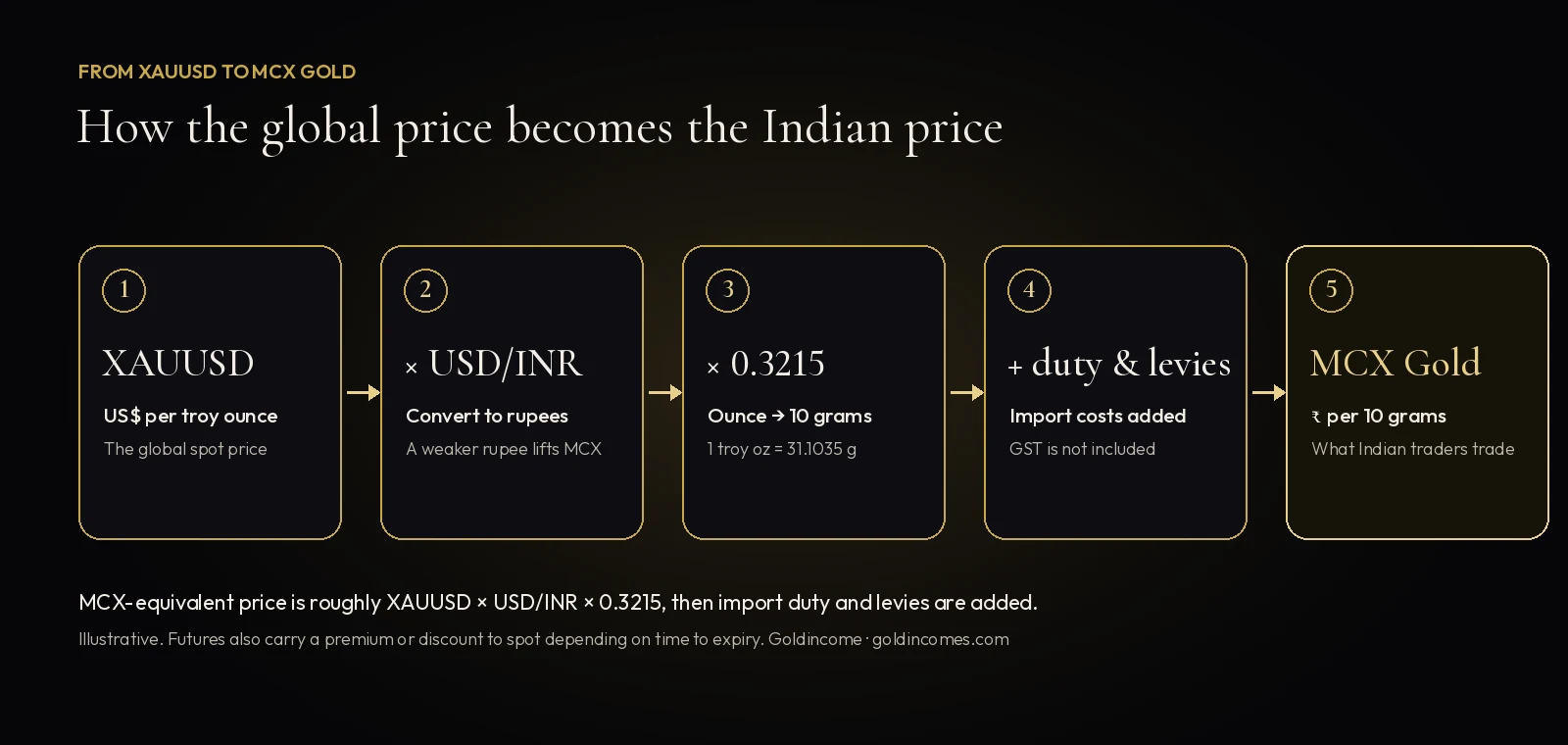
To compare them fairly, convert XAUUSD into rupees per 10 grams first:
MCX-equivalent price ≈ XAUUSD × USD/INR × 0.3215, before duty and levies
The remaining gap is mostly duty, plus the futures premium or discount for time to expiry.
How do the trading rules differ?
| XAUUSD | MCX Gold | |
|---|---|---|
| Currency | US dollar | Indian rupee |
| Price unit | Per troy ounce | Per 10 grams (Gold, Mini, Ten) |
| Type | Spot (over the counter) | Exchange-traded futures |
| Hours | Almost 24 hours on weekdays | Morning to late night IST; the close shifts with US daylight saving |
| Expiry | None for spot | Monthly expiry with delivery rules |
| Regulator | Depends on the broker's country | Traded on a SEBI-regulated Indian exchange |
Expiry matters on MCX. Gold and Gold Mini expire on the 5th of each month. Positions near expiry can move into the delivery (tender) period, which most short-term traders avoid by closing or rolling over in good time.
Can residents of India trade XAUUSD?
This is the question many traders skip, and it matters. Under India's foreign exchange law (FEMA), the Reserve Bank of India says residents may undertake forex transactions only with authorised persons and for permitted purposes. Permitted forex trading must be done on RBI-authorised platforms or recognised Indian exchanges, and the RBI publishes an Alert List of unauthorised forex trading platforms.
If you live in India, check the rules that apply to you before opening an account with any overseas platform, and never deposit money with an unauthorised one.
Which one should you watch?
Both, for different reasons.
- XAUUSD tells you the direction. Global news, the Federal Reserve and the US dollar move gold first in dollar terms.
- USD/INR tells you the translation. A strong move in the rupee can add to, or cancel out, a move in XAUUSD.
- MCX Gold is what Indian traders actually trade. Entry, stop-loss and target levels need to be in MCX terms, with the contract's lot size and expiry in mind.
That's why our research for MCX clients always reads XAUUSD and the rupee alongside MCX Gold, and our international guidance focuses on the London and New York sessions where XAUUSD does most of its moving.
Frequently asked questions
Is MCX Gold the same as XAUUSD?
No. Both follow the global gold market, but MCX Gold is a rupee-denominated futures contract quoted per 10 grams with import duty included, while XAUUSD is the US-dollar spot price per troy ounce. Currency moves, duty and contract rules mean the two can move by different amounts on the same day.
Why is MCX Gold higher than the international gold price?
The MCX price is the international price converted into rupees, with import duty and other levies added. It excludes GST. So even after converting units, MCX usually sits above the plain currency-converted XAUUSD price.
How many grams is one troy ounce of gold?
One troy ounce is 31.1035 grams. Ten grams, the unit MCX quotes in, is about 0.3215 troy ounces.
What is the smallest gold contract on MCX?
Gold Petal, at 1 gram per lot. MCX also lists Gold Guinea (8 grams), Gold Ten (10 grams), Gold Mini (100 grams) and the standard Gold contract (1 kg).
Should an Indian trader follow XAUUSD or MCX Gold?
Both. MCX Gold is the price you actually trade on an Indian exchange, but XAUUSD and the US dollar usually set the direction. Watching XAUUSD, USD/INR and MCX together gives the clearest picture.
Sources
- ICICI Direct — How to trade gold in the commodity derivatives market in India
- ICICI Direct — Know your commodity before you trade gold
- Aditya Birla Capital — MCX gold trading explained
- Reserve Bank of India — Alert List of entities not authorised to deal in forex
- MCX — Gold contract specifications (official)